Yiwu Market Insights
Yiwu vs Shenzhen vs Guangzhou: Which China Market Should You Visit?
Three of China’s most important sourcing destinations, compared by product strength, buyer profile, and how to combine them into one efficient trip.
China is not one market. Yiwu, Shenzhen, and Guangzhou each serve very different sourcing needs, and choosing the wrong one can waste a valuable trip. Understanding what each is genuinely good at is the first step to planning a productive visit.
Quick Comparison
| City | Best for | Buyer profile | Typical order |
|---|---|---|---|
| Yiwu | Small commodities, gifts, accessories, household goods | Wholesalers, retailers, multi-category buyers | Lower MOQ, mixed containers |
| Guangzhou | Apparel, leather goods, cosmetics, wholesale fashion | Brand owners, fashion and beauty buyers | Medium to large, seasonal |
| Shenzhen | Electronics, components, tech hardware | Tech brands, product developers, OEM buyers | Spec-driven, higher value |
These are general patterns. Every city has specialists beyond its headline categories — but the table is a reliable starting point.
1. Yiwu — The Multi-Category Trading Hub
Yiwu is home to one of the world’s largest wholesale markets, with tens of thousands of suppliers across accessories, gifts, toys, home products, stationery, and countless small commodities. Its real strength is breadth and flexibility.
- Best for: buyers who need many product categories in one place
- Advantage: low minimum order quantities and fast sample turnaround
- Consideration: many goods are made elsewhere in China and traded through Yiwu, so factory visits often happen in nearby production cities
Yiwu is often the most efficient first stop for buyers still exploring what to source. Our guide explains why Yiwu is more than just a wholesale market.
2. Guangzhou — Fashion, Beauty, and Wholesale Trade
Guangzhou is a major center for apparel, leather goods, footwear, and cosmetics, supported by the wider Pearl River Delta manufacturing base. It suits buyers whose products are style- or trend-driven.
- Best for: fashion, beauty, and lifestyle brands
- Advantage: strong supply of materials, packaging, and OEM/ODM partners
- Consideration: quality and compliance vary widely — supplier verification matters
One of our clients, a market and R&D team from Southeast Asia launching a new beauty line, came with little knowledge of China’s supply base. We arranged visits across Guangzhou, Yiwu, and multiple factories, connecting them with suppliers from raw materials to packaging — and changed how they viewed manufacturing in China.
3. Shenzhen — Electronics and Technology Hardware
Shenzhen and the surrounding Pearl River Delta are the go-to region for electronics, components, and tech hardware. The ecosystem is fast, engineering-heavy, and tightly integrated.
- Best for: electronics brands, hardware startups, and product developers
- Advantage: deep component supply chains and rapid prototyping
- Consideration: technically complex — product knowledge and clear specs are essential
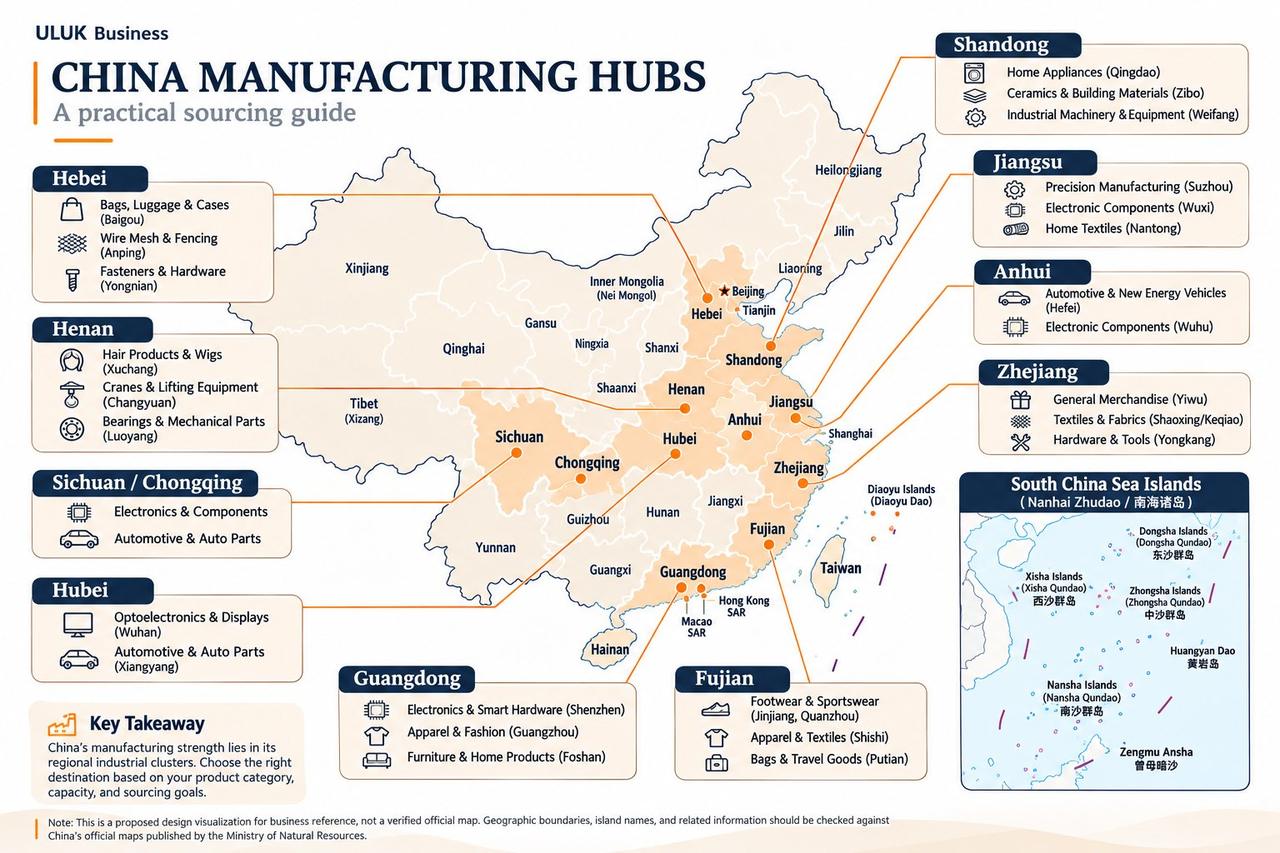
For a deeper look at which regions produce what, see our guide to China’s manufacturing hubs.
4. How to Choose
Start with your product, not the city. Ask what the product needs: breadth of choice, style and materials, or engineering and components. Then match that to the market built around it.
- Sourcing many small categories → start in Yiwu
- Building a fashion or beauty line → Guangzhou plus nearby factories
- Developing an electronic product → Shenzhen and the Pearl River Delta
5. Can You Combine Them in One Trip?
Yes — and many buyers should. Yiwu and Guangzhou are well connected by high-speed rail, and Shenzhen is a short hop from Guangzhou. A single week can cover all three if the itinerary is planned carefully.
| Trip length | Realistic scope |
|---|---|
| 3–4 days | One city, plus a nearby factory or two |
| 5–6 days | Two cities, with a clear focus in each |
| 7+ days | All three, with structured comparisons |
The risk of combining cities is packing too much into each day. A local team that knows the geography can sequence visits efficiently and arrange transport between cities.
6. Make the Market Work for You
Whichever city you choose, the goal is the same: turn a broad search into a shortlist of credible partners. Define your criteria before you arrive, take structured notes, and follow up quickly while details are fresh. A well-run visit to even one of these markets can reshape a sourcing strategy.
Frequently Asked Questions
Which China market is best for small-quantity, multi-category sourcing?
Yiwu. Its wholesale market covers a huge range of small commodities with relatively low minimum order quantities, which makes it ideal for buyers testing several product categories.
Is Guangzhou or Shenzhen better for OEM manufacturing?
It depends on the product. Guangzhou is strong in apparel, leather goods, and beauty, while Shenzhen and the Pearl River Delta specialise in electronics and tech hardware with deeper component supply chains.
Can I visit Yiwu, Guangzhou and Shenzhen in one trip?
Yes. A week is realistic for all three if the itinerary is well planned. High-speed rail connects them efficiently, though three to four days suits a single city better.
Do I need a local guide to visit these markets?
Strongly recommended. Local teams help with interpretation, supplier shortlisting, transport between cities, and distinguishing trading stalls from genuine factories.
Are prices lower in Yiwu than in Guangzhou?
Not necessarily — it depends on the product and order size. Yiwu is often better for small mixed orders, while factory-direct pricing in industrial clusters can be lower at larger volumes.
Visit the Right Market, With the Right Plan
Not sure which city fits your product? Our Yiwu-based team will help you compare options and build an itinerary that makes the trip count.