
China Sourcing
Understanding China’s Manufacturing Hubs: Where to Source What
A practical guide to China’s major manufacturing regions and how international buyers can choose the right sourcing destinations.
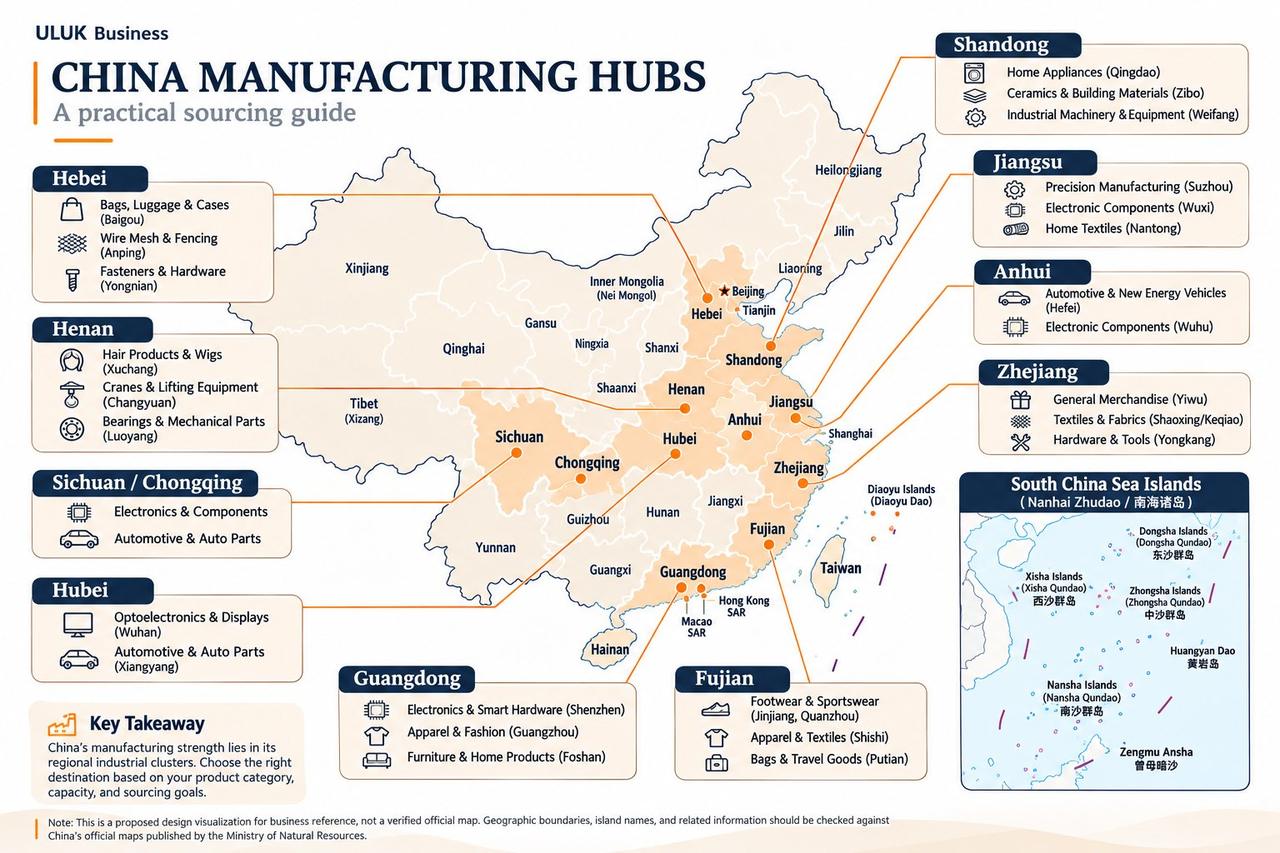
China is one of the world’s most diverse manufacturing economies. Yet its industrial capabilities are not concentrated in a single city or province.
From electronics in Guangdong to consumer goods in Zhejiang, industrial equipment in Shandong, and specialized manufacturing clusters in Hebei and Henan, different regions offer distinct sourcing opportunities.
For international buyers, knowing where to look is often the first step toward finding the right supplier.
1. Understanding China’s Manufacturing Clusters
China’s manufacturing strength is supported by regional industrial clusters — geographic networks of factories, material suppliers, component manufacturers, service providers, and logistics businesses.
These clusters allow buyers to research multiple suppliers within a specialized industry.
However, a well-known manufacturing region does not guarantee that every factory is suitable. Quality systems, manufacturing capabilities, pricing, and supplier reliability must still be evaluated individually.
2. China’s Major Manufacturing Regions
Zhejiang — Consumer Goods, Textiles & Hardware
Zhejiang offers a combination of wholesale trading markets and specialized manufacturing centers.
- Yiwu: General merchandise, gifts, accessories, and household products.
- Shaoxing (Keqiao): Textiles, fabrics, and related materials.
- Yongkang: Hardware, tools, and metal products.
- Ningbo: Home appliances, plastics, and manufacturing components.
Yiwu is particularly useful for multi-category sourcing, although products sold there may originate from factories throughout China.
Guangdong — Electronics, Fashion & Consumer Manufacturing
The Pearl River Delta is an important manufacturing and product development region.
- Shenzhen: Electronics, smart hardware, and electronic components.
- Dongguan: Electronics manufacturing, plastics, and contract production.
- Guangzhou: Apparel, textiles, and fashion accessories.
- Foshan: Furniture, ceramics, and home appliances.
- Zhongshan (Guzhen): Lighting products and components.
Guangdong is especially relevant for businesses developing consumer products and customized manufacturing projects.
Jiangsu — Precision Manufacturing & Industrial Supply Chains
Jiangsu is recognized for industrial manufacturing, technical components, and specialized production.
- Suzhou: Precision engineering and electronics.
- Wuxi: Industrial equipment and manufacturing components.
- Changzhou: Industrial machinery and automotive supply chains.
- Nantong: Home textiles.
The region is particularly relevant to buyers seeking technical manufacturing and industrial suppliers.
Shandong — Appliances, Machinery & Materials
Shandong is a major industrial province with capabilities across consumer and industrial manufacturing.
- Qingdao: Home appliances and electronics-related manufacturing.
- Zibo: Ceramics, advanced materials, and glass-related industries.
- Weifang: Industrial machinery, power equipment, and manufacturing.
- Linyi: Building materials, wood products, and trading networks.
Shandong deserves consideration when sourcing appliances, industrial equipment, ceramics, or construction-related materials.
Hebei — Specialized Consumer & Industrial Products
Hebei has numerous product-focused manufacturing clusters that are highly relevant to international sourcing.
- Baigou: Bags, luggage, and related accessories.
- Anping: Wire mesh, fencing, and metal mesh products.
- Qinghe: Cashmere and related textiles.
- Yongnian: Fasteners, bolts, and nuts.
- Tangshan: Ceramics and sanitary ware.
- Pingxiang: Children’s bicycles and related products.
These specialized clusters can help buyers identify relevant manufacturers beyond China’s better-known coastal trading centers.
Henan — Hair Products & Industrial Equipment
Henan combines specialized consumer products with established industrial manufacturing.
- Xuchang: Wigs, hair extensions, and related hair products.
- Changyuan: Cranes and lifting equipment.
- Luoyang: Bearings, machinery, and industrial components.
- Zhengzhou: Electronic information and equipment manufacturing.
For hair product brands and industrial equipment buyers, Henan offers important sourcing opportunities that should not be overlooked.
Fujian — Footwear & Apparel
- Jinjiang and Quanzhou: Sports footwear, athletic apparel, and related materials.
- Shishi: Casual clothing and textile-related manufacturing.
- Putian: Footwear supply chains.
These locations are relevant to footwear, sportswear, and apparel businesses.
Other Important Manufacturing Regions
China’s manufacturing capabilities extend well beyond these provinces.
- Anhui: Automotive manufacturing, new-energy vehicles, and electronic components.
- Hubei: Optoelectronics, automobiles, and automotive components.
- Sichuan and Chongqing: Electronics, automobiles, and industrial equipment.
- Shaanxi: Aerospace-related manufacturing and industrial technology.
- Liaoning: Machinery, equipment, and heavy industry.
The right destination depends on the product and manufacturing capabilities required.
3. Where Should You Source Your Products?
| Product Category | Suggested Sourcing Locations |
|---|---|
| General merchandise & gifts | Yiwu, Zhejiang |
| Bags & luggage | Baigou, Hebei |
| Wigs & hair extensions | Xuchang, Henan |
| Apparel & textiles | Guangzhou, Keqiao, Shishi |
| Footwear & sportswear | Jinjiang, Quanzhou, Putian |
| Electronics & smart hardware | Shenzhen, Dongguan |
| Home appliances | Qingdao, Foshan, Ningbo |
| Furniture | Foshan, Guangdong |
| Hardware & tools | Yongkang, Zhejiang |
| Fasteners & wire mesh | Yongnian, Anping, Hebei |
| Ceramics | Zibo, Tangshan, Foshan |
| Industrial machinery & bearings | Luoyang, Wuxi, Weifang |
| Automotive components | Changzhou, Wuhan, Chongqing |
These locations are starting points for research rather than exclusive manufacturing destinations.
4. Trading Markets vs. Manufacturing Locations
International buyers should distinguish between a product’s trading location and its manufacturing origin.
For example, a product displayed in Yiwu may be manufactured in Zhejiang, Guangdong, Hebei, Henan, or another province.
Trading markets help buyers discover products and compare suppliers. Manufacturing clusters help buyers identify production capabilities and specialized factories.
Understanding this difference is especially important for customized products, larger orders, and long-term supplier relationships.
5. How to Choose the Right Sourcing Destination
A practical sourcing strategy should follow five steps.
1. Define Your Requirements
Identify product categories, specifications, purchase quantities, budget, and customization needs.
2. Research Manufacturing Regions
Determine which regions specialize in your products and whether trading markets or factories are more relevant.
3. Shortlist Suppliers
Compare potential suppliers based on capabilities, quotations, MOQ, and product requirements.
4. Plan Targeted Visits
Arrange market visits for product exploration and factory visits for manufacturing evaluation.
5. Verify and Follow Up
Review samples, clarify commercial terms, evaluate suppliers, and document next steps.
A focused visit to the right industrial cluster can be more productive than traveling across multiple cities without clear objectives.
6. How ULUK Supports Your China Sourcing Journey
At ULUK Business, we help international clients navigate China’s regional sourcing opportunities through research, supplier coordination, and tailored business visits.
Our services include:
- Industry and manufacturing cluster research.
- Product and supplier sourcing.
- Customized market research and sourcing reports.
- Supplier and factory visit coordination.
- Tailored multi-city business itineraries.
- Local communication and project support.
Whether you’re researching manufacturing regions remotely or planning a visit to China, we help align your sourcing activities with your business objectives.
Final Thoughts
China’s manufacturing ecosystem is far more diverse than a handful of major trading cities.
The most effective sourcing strategy starts with understanding your product, identifying the right manufacturing region, and evaluating suitable suppliers.
From Yiwu’s trading ecosystem to Shandong’s industrial manufacturing, Hebei’s specialized clusters, and Henan’s distinctive industries, each region can offer different advantages.
Choosing the right destination helps turn a broad sourcing search into a more focused business decision.
Explore China’s Manufacturing Opportunities
Planning a sourcing project, industry research, or a business visit to China?